
THE STAKES
What a single order reveals about your customer
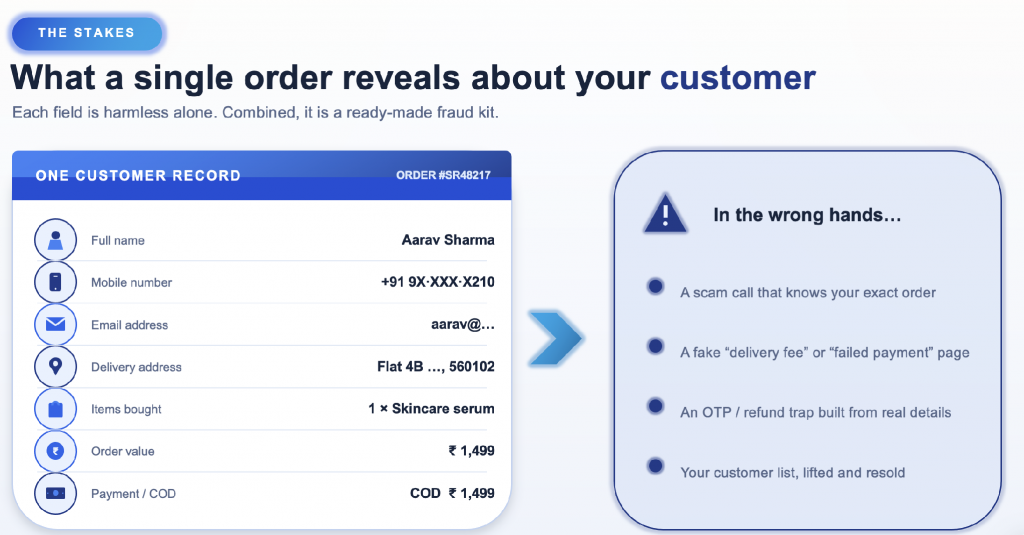
Every order generates a rich set of customer information such as name, phone number, email address, delivery location, order details, and payment information. Individually, these data elements may seem routine. Combined, they create a highly contextual profile that enables someone to convincingly impersonate a brand, a delivery partner, or a customer support representative.
This is why protecting customer data is not just about securing individual records, it is about safeguarding the complete picture they create when brought together.
THE MECHANISM
From leak to fraud: why these scams work
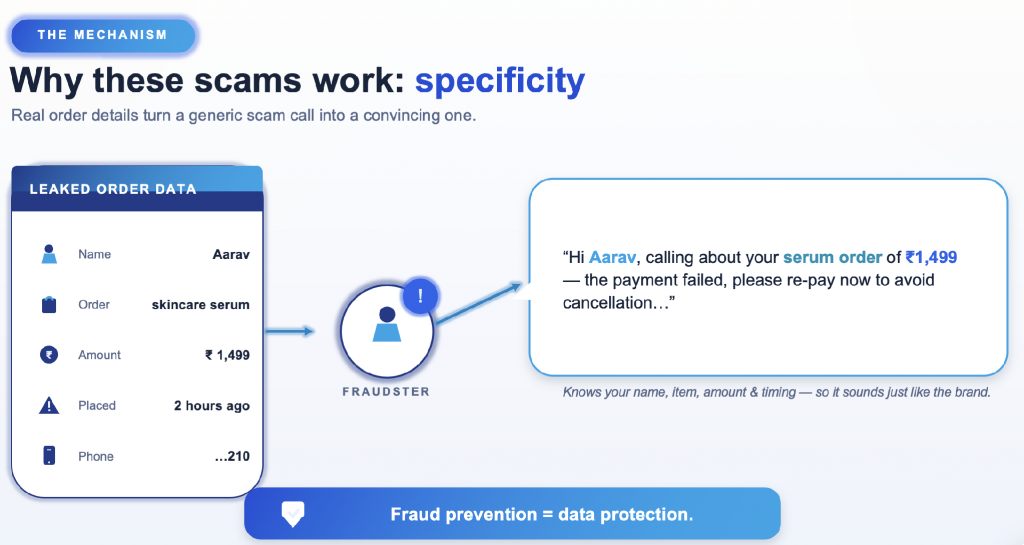
Leaked order data fuels modern fraud. When someone knows a customer’s name, order details, delivery status, or payment amount, fraudulent calls and messages become far more convincing.
This is why data protection and fraud prevention are two sides of the same coin: reducing data exposure reduces opportunities for fraud.
THE THREATS
Scams that target your customers
These are the scams your customers actually encounter. Each is built on details that escaped a single order which is why they feel so believable.
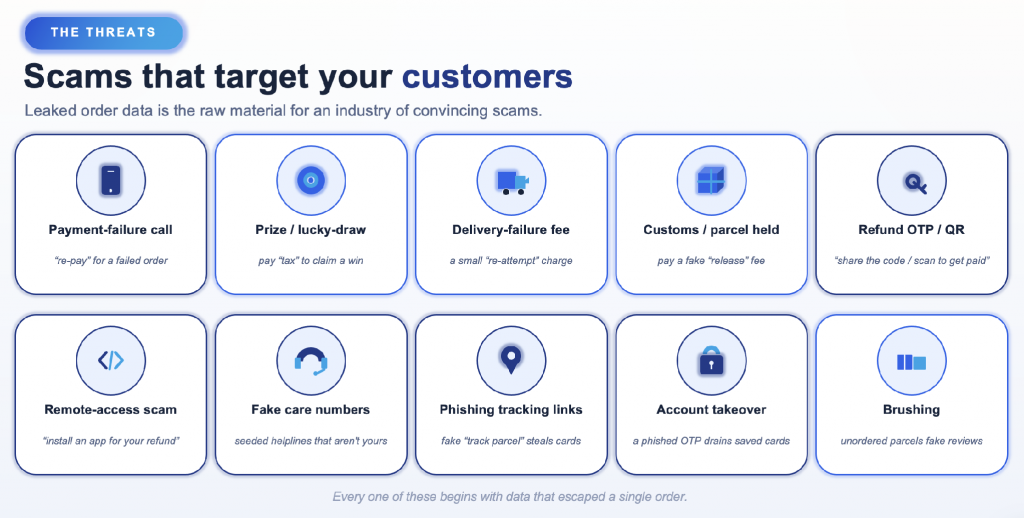
| Scam | How it plays out | What makes it possible |
|---|---|---|
| Payment-failure call | “Support” says your payment failed and sends a link to “retry” you pay twice. | Leaked order ID, amount & phone, hours after the order |
| Prize / lucky-draw | A caller confirms your purchase; says you’ve won, just pay a “tax” to claim it. | Leaked order history that sounds authentic |
| Delivery-failure fee | “Address incomplete, pay a small re-attempt fee.” The page harvests card / UPI details. | Leaked tracking status & phone |
| Customs / parcel held | “Your parcel is held, pay a duty / release fee.” | Knowledge that a parcel is genuinely in transit |
| Refund OTP / QR | “Share the OTP for your refund,” or “scan this QR to get paid.” (QR codes only pay out.) | Order details + OTP / UPI unfamiliarity |
| Remote-access scam | “Install an app to process your refund” and then they watch you bank. | A refund pretext built from real order data |
| Fake care numbers | Fake helpline numbers seeded on search / social; buyers call the fraudster. | Lack of clearly published official support channel |
| Phishing tracking links | Fake “track your parcel” pages steal cards, PINs or logins. | Buyers trained to click tracking links |
| Account takeover | A phished OTP or reused password drains saved cards and wallets. | Credential reuse and OTP-sharing |
| Brushing | Parcels nobody ordered, using leaked names to fake reviews. | Bulk-leaked name & address lists |
THE DEFENCE
Measures to safeguard your customers’ data
Fraudsters will continue to evolve their tactics, but their success depends on access to customer data and weak control points. By reducing unnecessary data exposure and strengthening security across the customer journey, organizations can significantly limit opportunities for misuse. The good news is that many of these measures are practical, cost-effective, and achievable for businesses of any size, regardless of the platform they operate on.
- Strengthen access controls: Ensure every user has a unique account, grant only the minimum access required, and regularly review access across commerce, logistics, support, and analytics platforms.
- Enable MFA across the ecosystem: Protect administrative accounts, marketplace portals, courier platforms, business email, and other critical systems with multi-factor authentication.
- Review integrations and API access: Regularly assess applications, plugins, webhooks, and API keys; remove unused integrations, rotate credentials, and validate permissions.
- Minimize data on shipping labels: Display only information required for delivery and avoid exposing unnecessary customer or order details.
- Govern data exports: Restrict bulk exports, mask sensitive fields where possible, maintain audit logs, and monitor for unusual download activity.
- Protect customer communications: Use virtual contact mechanisms where feasible, establish clear data handling requirements with logistics partners, and define retention limits for customer information.
- Build trust through consistent communication: Use verified communication channels and educate customers on how your organization “will” and “will not” contact them.
- Monitor for brand impersonation: Continuously watch for fraudulent websites, social media accounts, support channels, and other attempts to misuse your brand.
- Prepare for incidents before they happen: Maintain a tested response plan that covers investigation, customer communication, regulatory obligations, and remediation activities.
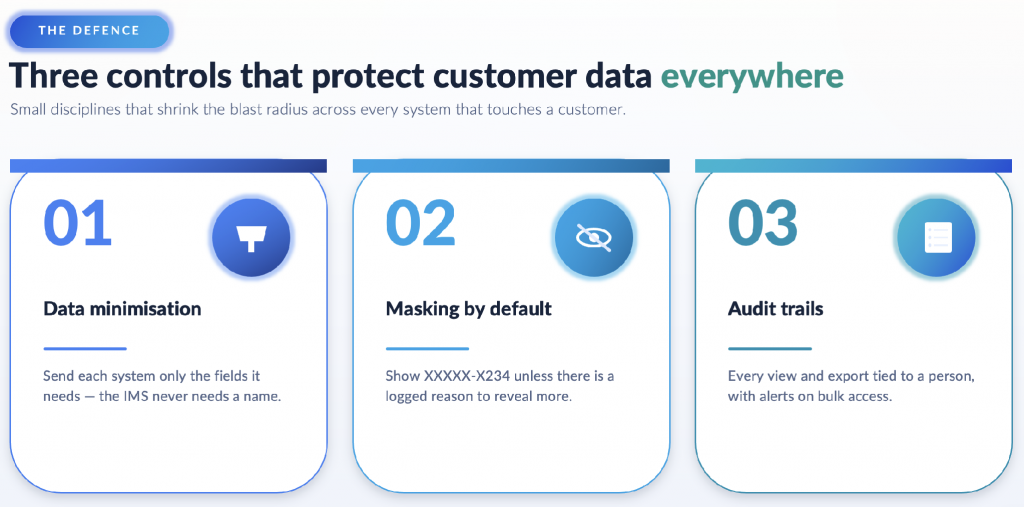
Below three controls should be considered as the core principle as they are the key of protecting customer data.
HOP BY HOP
What each system owes your customers
System by system, those principles become concrete. Use this as a checklist and share it with every partner. The dot color shows how much of your customer’s data each system holds.
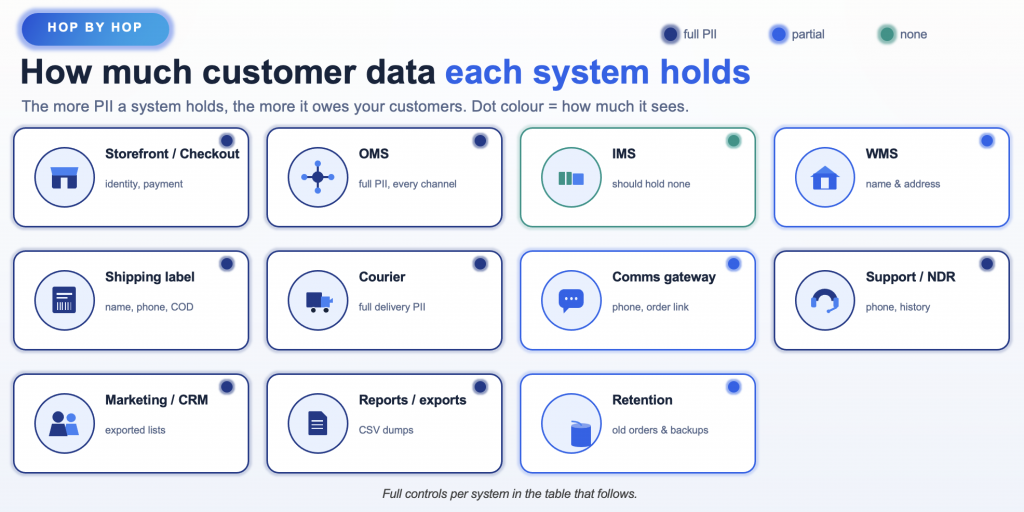
| System | Customer data it holds | Key controls required |
|---|---|---|
| ● Storefront / marketplace / checkout | Identity, payment, browsing | PCI-DSS; encrypt; share only fulfilment fields |
| ● OMS | Full PII, every channel | RBAC; mask by default; audit & alert on exports |
| ● IMS | Should hold none | No buyer fields — reject at the interface |
| ● WMS | Name, address on slips | Mask phone on slips; no personal phones on the floor |
| ● Shipping label | Name, phone, address, COD | Mask phone; drop email; minimal print |
| ● Courier / aggregator | Full delivery PII | DPA terms; virtual numbers; auto-purge after delivery |
| ● Comms gateways | Phone, name, order link | Minimum variables; DLT templates; no full address |
| ● Support & NDR / RTO | Phone, address, history | Reveal-on-click + logging; audit outsourced centers |
| ● Marketing / CRM | Exported lists & audiences | Consent before export; hash audiences; DLP on exports |
| ● Reports & exports | CSV / Excel dumps | Mask columns; log; expiring links; approval to export |
| ● Retention & disposal | Old orders, logs, backups | Retention schedule; auto-purge / anonymize; encrypt backups |
THE MINDSET
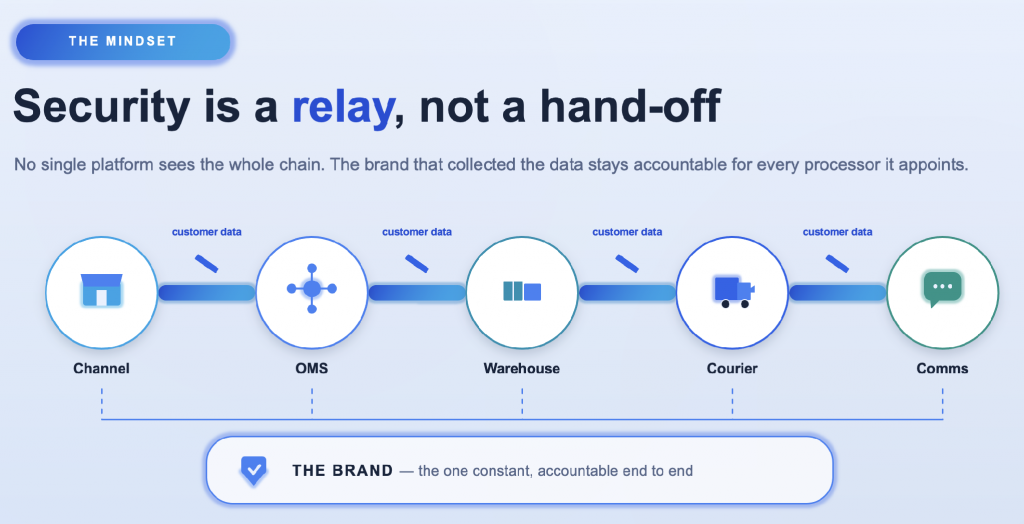
Security is a relay, not a hand-off
Protecting customer data is a shared responsibility across the commerce ecosystem. No single platform, service provider, or partner has visibility into the entire journey. Every participant plays a role in safeguarding the information entrusted to them.
While customer data may pass through multiple systems and organizations, accountability remains with the brand that collected it. That makes vendor governance, transparency, and security due diligence critical. Organizations should regularly engage with their partners and seek clear answers on how customer data is accessed, protected, retained, and shared throughout the lifecycle.
| FIVE QUESTIONS FOR EVERY PARTNER |
As customer data moves across multiple partners and platforms, transparency becomes essential. Every organization in the ecosystem should be able to clearly answer a few fundamental questions:
- What customer data is required for your service, and can access be limited to only the information necessary to perform that function?
- Who can access customer data within your organization, and are appropriate controls and audit logs in place to monitor that access?
- How is customer information protected within operational processes such as labels, packing slips, agent interfaces, and delivery workflows?
- How long is customer data retained, and what processes exist to securely delete or dispose of it when it is no longer needed?
- In the event of a security incident involving customer data, how and when will affected parties be notified?