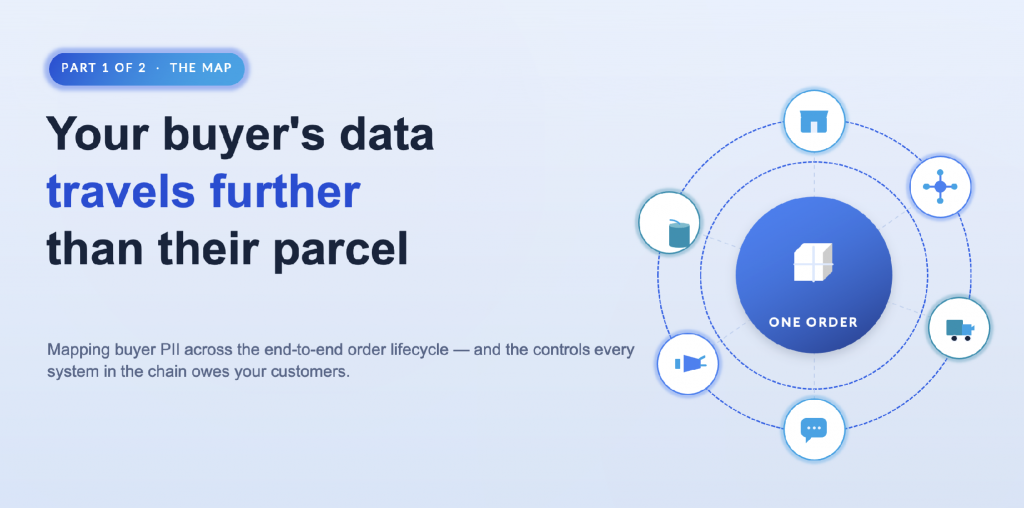
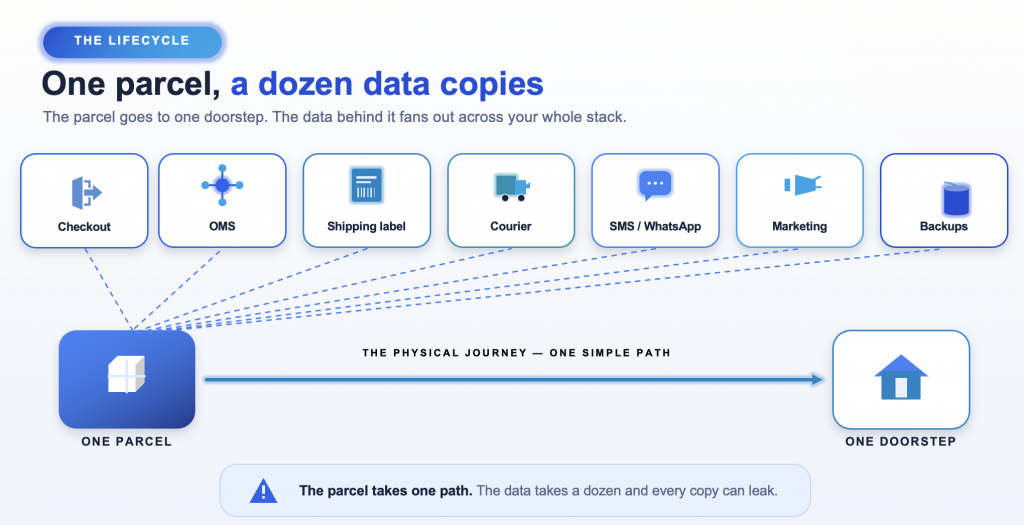
| THE THESIS The parcel goes to one doorstep. The data behind it fans out across your whole stack and is only ever as secure as the weakest link in the chain. |
When a customer clicks “Place Order”, their data doesn’t stay with one brand. It travels across payment providers, order-management systems, warehouses, logistics partners, communication platforms, analytics tools and marketing services. That interconnected flow delivers the speed and convenience shoppers expect and means customer data is only as secure as the weakest link.
The real challenge is not simply securing your own applications, but understanding how customer data moves across partners and ensuring the right controls exist at every hand-off. Data security is no longer about protecting a database; it is about securing the entire journey of customer data.
WHAT’S AT STAKE
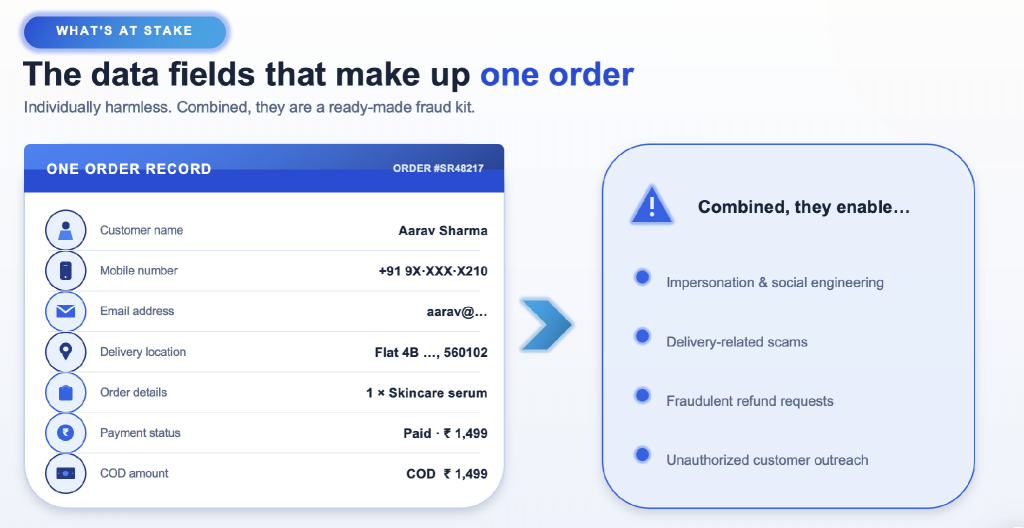
The data fields that make up one order
The data flowing through the ecosystem is usually the same: customer name, mobile number, email, delivery location, order details, payment status and — for Cash on Delivery — the amount to collect. Individually, each field looks routine.
Combined, they create a highly contextual profile that can be misused for impersonation, social engineering, delivery-related scams, fraudulent refund requests or unauthorized outreach. Protecting customer data is not just about securing individual records — it is about safeguarding the context they create when those fields are brought together.
THE CAST
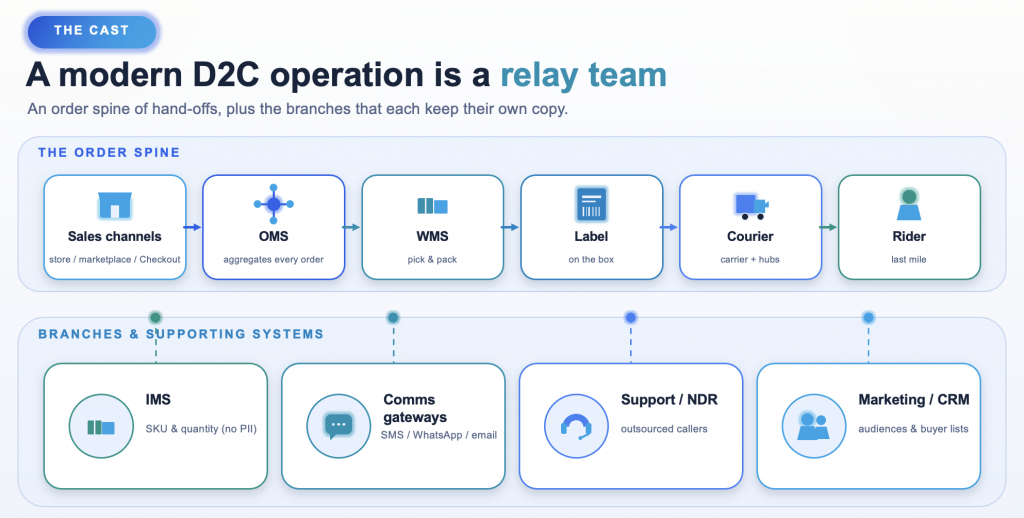
A modern D2C operation is a relay team
Orders run along a spine of systems — sales channels feed order-management platforms, inventory tracks stock, warehouses pick and pack, labels are generated and logistics partners deliver — with a supporting cast of communication, support, analytics, CRM and marketing tools around it.
Each participant needs specific customer information to do its job. The discipline is ensuring every system receives only the data it truly needs and nothing more. Effective data protection begins with minimizing exposure at every step of the journey.
THE MAP
Following the data: twelve hops
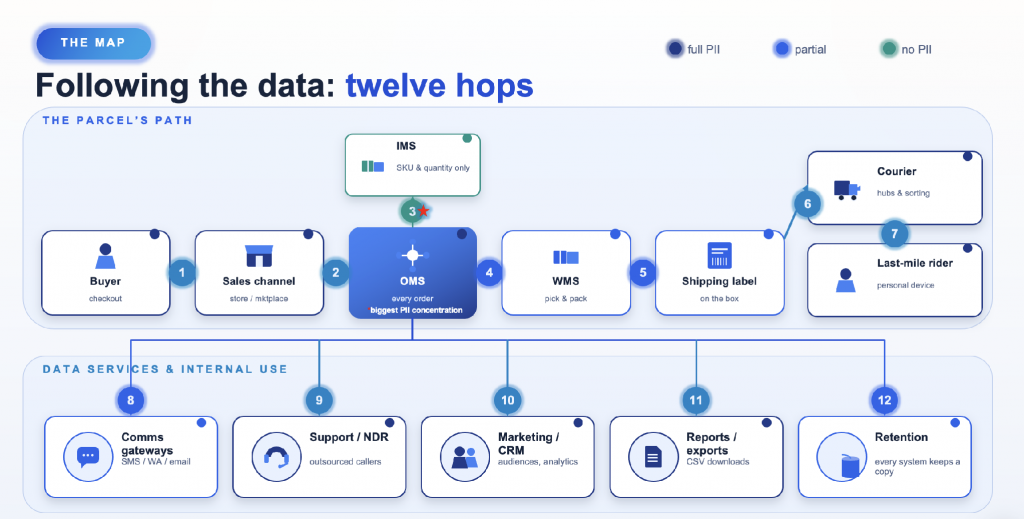
The diagram below follows a single order, marking each point where customer data moves between systems and/or often between organizations. Each numbered step is a data hand-off: an opportunity to run the business, but also a point where security and privacy controls become essential.
| # | Hand-off | What moves |
|---|---|---|
| ● 1 | Buyer → sales channel | Name, contact details, address and payment information shared at checkout. |
| ● 2 | Channel → OMS | Order and customer information flow into the Order Management System — the central hub. |
| ● 3 | OMS → IMS | Inventory systems need only product and quantity information, not customer identity. |
| ● 4 | OMS → WMS | Warehouse systems receive what’s needed to pick, pack and prepare the order. |
| ● 5 | WMS → shipping label | Partial customer information is printed on labels — data beyond digital systems. |
| ● 6 | Manifest → courier | Delivery details are shared with logistics partners to enable shipment and tracking. |
| ● 7 | Courier → last-mile rider | Delivery personnel receive what they need to complete the final hand-off. |
| ● 8 | Order events → comms platforms | SMS, WhatsApp and email providers receive limited data to send updates. |
| ● 9 | Failed deliveries → support / NDR | Support (often outsourced) and NDR teams access data to resolve issues. |
| ● 10 | Orders → marketing & CRM | Customer data powers engagement, loyalty, personalization and campaigns. |
| ● 11 | Reports & exports | Customer information is exported into reports, dashboards and spreadsheets. |
| ● 12 | Retention & disposal | Data persists in databases, logs, backups and archives long after completion. |
REALITY CHECK
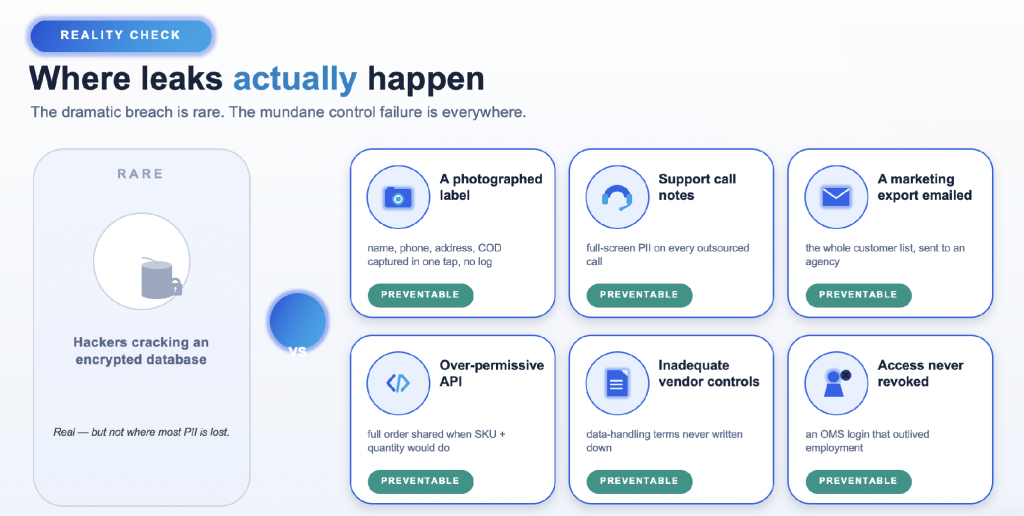
Where leaks actually happen
High-profile breaches make headlines, but most exposures are far less dramatic. They come from everyday gaps: a label captured in a photo, customer details noted on a support call, a marketing list shared externally, an over-permissive API, an unused app on the store, weak vendor controls, or access never revoked after someone left.
Each traces back to a specific point in the data journey where a control was missing or ineffective. The encouraging part: these are not inevitable risks. They are manageable, measurable and largely preventable with the right security and governance practices.